
Gen Z Bisexual Boom: Number of Under-35s Identifying as ‘Bi’ Quadruples in a Decade — But Is the Trend Now Reversing?
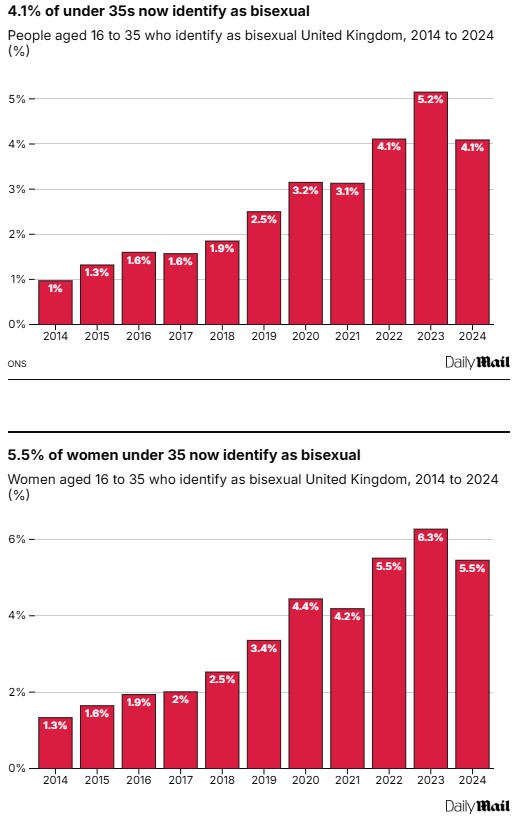
A boom in bisexuality among Generation Z has been laid bare in official figures today. The proportion of under-35s identifying as ‘bi’ has quadrupled in the past decade, from 1 per cent in 2014 to 4.1 last year.
That includes an extraordinary surge among women, with the level hitting 5.5 per cent. However, the latest Office for National Statistics (ONS) data suggested there might have been a shift in the latest year – with more men in the age bracket classing themselves as gay.
The ONS survey found the overwhelming majority of people in the UK regard themselves as heterosexual, at 93.4 per cent.
Younger people were more likely to identify as lesbian, gay or bisexual (LGB) than older people. Some 8 per cent of 16-24 year-olds identified in those categories, compared with 1.2 per cent aged 65 and over.
The percentage identifying as LGB has been growing fastest for 25-34 year-olds, going from 3.6 per cent in 2019 to 6.4 per cent in 2024. Men were more likely to identify as gay – 2.9 per cent – than bisexual – 1.1 per cent – last year. However, women were more likely to identify as bisexual than gay or lesbian by a margin of 2 per cent to 1.4 per cent.
Analysis of the ONS data shows that in 2014 1 per cent of under-35s classed themselves as bisexual. By last year that had risen to 4.1 per cent. However, the figure was down from a peak of 6.3 per cent in 2023. Among women, 1.3 per cent said they were bisexual in 2014, rising to 5.5 per cent last year. But in 2023 the proportion reached 6.3 per cent.
The reasons for the shifts are unclear, but the percentage of men identifying as gay in the younger age group did rise between 2023 and 2024, at the same time as the proportion saying they were bisexual dipped. The ONS prefers comparisons over longer period due to variations in the sample of people responding to its Annual Population Survey.
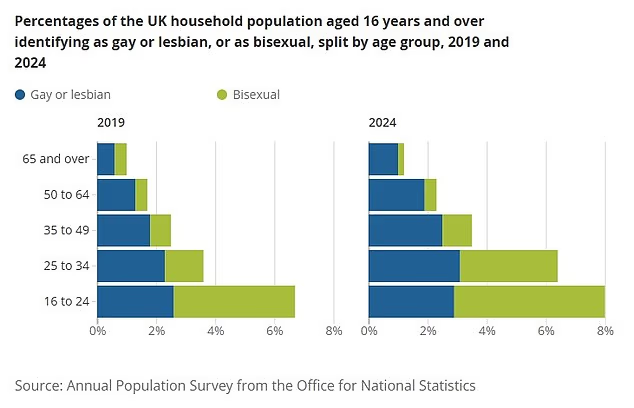
Emily Knipe of the ONS said: ‘While the people in their late teens and early 20s are the most likely to identify as lesbian, gay or bisexual, in 2024 we saw the fastest growth in the LGB population among people in their late 20s and early 30s.
‘Specifically there are more people, especially women, in this age bracket identifying as bisexual.
‘This is likely due to a cohort effect as people who identified as LGB in their teens are getting older.
‘However, it will also reflect increasing social acceptability in recent times.’